The 'direct-via-email' winner was the ever-spectacular Mistress MJ, who sent me a message with the answer mere minutes after the quiz was posted.
The 'guess-in -the-comments' winner is the lovely and demure Donna Lethal, who mentioned a resemblance between Mister and her pooch Chester. Now that she mentions it, I can see it.
For being the first answer MJ will receive, for her prize, on her next visit to Hollywood, a nice long walk. Walking tour, that is.
Well I guess I'll never stop learning about this history-rich neighborhood of mine!
Balcones
On the southeast corner of Vine St. and DeLongpre Ave (1 block south of Sunset) is this really cute little Peruvian restaurant called Los Balcones. I've been meaning to try it for sometime. Well now I can't wait to get in there, and not just for a steaming plate of Parihuela either. No, I want to conjure up some spirits!
It turns out that for a few years, starting in the mid 40s the space where the restaurant is (combined with the psychic's joint next door and the little market next to that) was Billy Berg's.
Billy Berg's was a nightclub. Okay, not just a nightclub, but a nightclub of Happenings!
For starters it was the first commercial nightclub in Hollywood to be fully integrated - from stage to audience black and white could at last hang out together.
The room was opened in Feb of '45 by Coleman Hawkins. Next up on the bill in May was the brilliant and 'vout-oreenie' Slim Gaillard (the man who coined the term 'groovy'). You'll be hearing more from Slim shortly, but if you don't know him, sniff around the web a lil bit and get informed. You'll be glad.
Right after Slim's residency, Berg brought in way-out Harry The Hipster:
Harry Gibson (who, btw, coined the term 'hipster') was a whacked out, Harlem jivin', boogie woogie piano pounding blond white kid from the Bronx who's career was re-discovered in the 70s.
Harry The Hipster Gibson on stage at Billy Berg's, Aug. '45
When he hit it at Berg's he was fresh, trending and in the know. Berg asked the Hipster to recommend a hot act from 52nd street for him to bring out for the club. Harry didn't even hesitate. He told the impresario of this cat named Dizzy who had a quintet that was 'gone daddy, I mean gone!' And there was another cat in the act called Bird who was stratospheric!
Parker and Gillespie
Billy Berg made the deal. He bought the Dizzy Gillespie Quintet for eight weeks. A brilliant and innovative musician, Gillespie was also a cagey businessman. Parker by this time was already becoming unpredictable. He might or might not show up on any given night. Hedging his bets, Dizzy hired Milt Jackson (the first bop vibraphonist) out of his own pocket as an addition for the date. That way, if Bird was too high to blow, there would still be a 5-man act to fulfill the contract. They were supposed to play three sets per night.
On December 10th, 1945, Bop hit town and Hollywood went into orbit. Kind of. The first set came and went with no Charlie Parker. The second set -- same thing. Parker was not nodding off in some hotel room as you might suspect, he was in fact backstage in the dressing room consuming two complete orders of Comida Conquistador (a huge Mexican sampler platter that was the kitchen's specialty) and drinking tumblers of gin. Finally when The Bird was stuffed, he entered the showroom from the back blowing a crazy solo on "Cherokee". Weaving his way through the audience, a hail of notes was shooting out of the horn like a tommy gun. One by one, the rhythm section fell in with him and by the time he hit the stage, the whole band was cooking, but plenty. The crowd, it is safe to say, went wild.
Bird on stage at Berg's
The place was packed for the first two weeks mostly out of curiosity, but ultimately the crowds tapered off to be pretty much just other jazz musicians. Los Angeles simply wasn't ready. This was the land of warmth and flowers and beaches and melody. They were having trouble wrapping their sun-baked minds around a sound that was so icy/hot, so full of smoke and concrete and dope and flat ninths and sharp elevenths. L.A. was still speaking hep; they hadn't yet moved into hip.
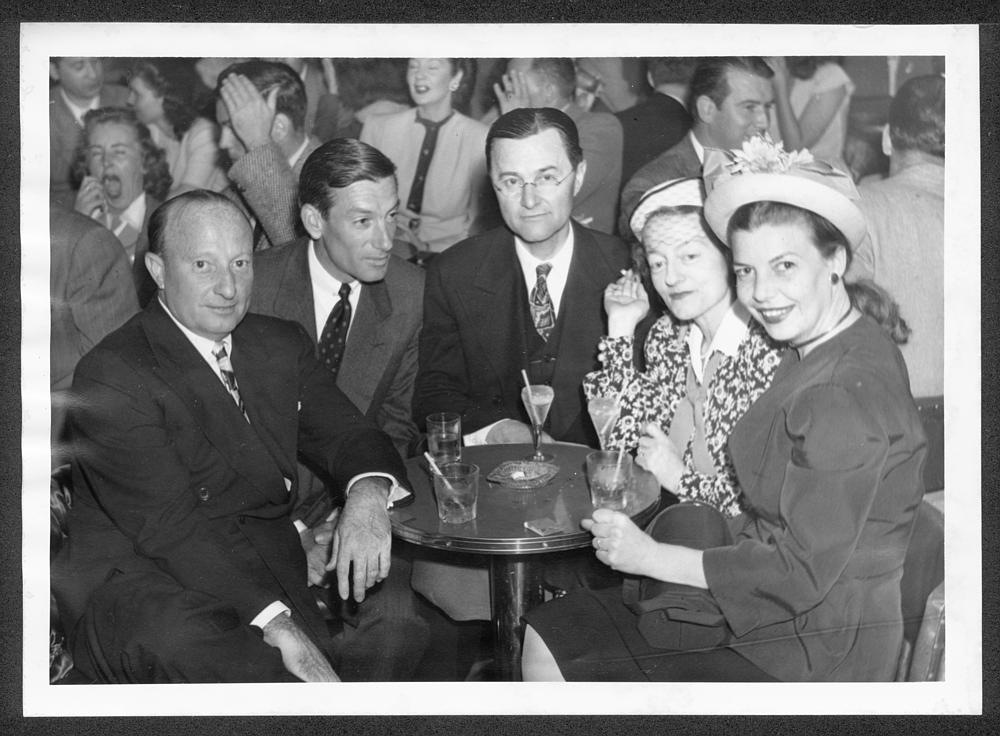
One night in 1946 Hoagy Carmichael was enjoying an evening at Berg's club when he heard a familiar sound.
Hoagy Carmichael (2nd from L.) and party at Berg's
On stage was a guy who was born with the name Francesco LoVecchio that the bands would allow to sing for free in between sets. He had just launched into the chestnut "Rockin' Chair", which Hoagy had written a decade before. Carmichael loved the way the kid sang his song. Calls were made, recording dates were set for a tune called "That's My Desire" and in no time the whole world knew Frankie Laine!
Everybody played there -- all the stars went there. On August 13, 1947 the father of jazz, Louis Armstrong debuted his new band The All Stars at Berg's.
Then it was December 15th, 1948, that the incomparable Lady Day began an engagement at the club. At this point in her life, drug busts and prison sentences behind her, unpredictable things had a way of cropping up. And so we shouldn't be too surprised that on New Year's Eve a rumble broke out in the kitchen with Billie smack in the middle of it all. Before all was said and done, Lady had smashed every dish she could get her hands on and her lover-of-the-moment, Johnny Levy, had buried a butcher knife into the shoulder of some poor bastard bystander that wasn't even involved in the fracas. Holiday and Levy were hauled off to jail.
Billie leaves the courthouse.
Oh, and if all that isn't surreal enough for you, did I mention: Tallulah was there!
Here is an audio clip that was recorded on her opening night of a beautiful tune called "Maybe You'll Be There". Holiday is backed up by Red Norvo and the boys:
I don't know how long into the 50s Billy Berg's stayed in business, but I do know that I have a new place in the neighborhood to go and feel some way out vibes.....
Looking at this picture of the great Jerome Kern and the irresistible Jean Harlow on the set of "Reckless", my first thought is of the Kern standard "Yesterdays". It's words seem a perfect fit for "The Baby" in this, her centenary year.
These are the wistful Otto Harbach lyrics:
Yesterdays
Yesterdays
Days I knew as happy sweet
Sequestered days
Olden days
Golden days
Days of mad romance and love
Then gay youth was mine
And truth was mine
Joyous free and flaming life
Forsooth was mine
Sad am I
Glad am I
For today I'm dreaming of
Of yesterdays
The only version of this song for me is by Billie Holiday. Lady Day herself called this her favorite song. Enjoy
Fifty-one years ago today the world got a little quieter - and not in a good way - as the magnificent Billie Holiday returned to Fabulon.
I have a breathtaking short story by Francoise Sagan on her memories of Lady Day. In it she describes her very first visit to America on a publicity junket for her book, "Bonjour Tristesse". Apart from selling her book, her main objective of the visit was to find and hear Billie sing. Well find her she did, and Holiday was so taken with her and her traveling companion, composer Michel Mange, that they became inseparable for the next two weeks. It was a rollicking good time. Billie was healthy, in strong voice and charming. The two french kids were entranced.
A few years later and back in Paris, Sagan read in the paper that Holiday was to perform at the Mars Club. They had lost touch but she was very excited to see her friend again. The end of the story describes that evening:
"It was Billie Holiday - and yet it wasn't. She had grown thin; she had aged; and her arms bore the ever closer tracks of needles. She no longer had that innate assurance, that physical equilibrium which had conferred on her such a marble-like serenity amid the storms and dizzy turbulence of her life.
We fell into each other's arms. She began to laugh and I instantly recovered a sense of exaltation, that romantic childlike exultation I had known in a now-distant New York, a New York clothed in music and the night as some children are clothed only in blue or white. I introduced my husband to her; he was rather disconcerted by her presence, which seemed both completely natural and at the same time quite exotic; and it was only then that I realized how many million light-years of difference there were between us, or rather, how many million years of darkness separated me from her, and how she had so wonderfully and with such friendliness been happy to wipe out that difference during the fortnight now long past. A host of things had been put aside during our first meeting; the problem of race, of her courage, of her fight to the death against poverty, prejudice, lack of identity, against whites and non-whites; against alcohol, the wickedest of enemies, against Harlem, against New York; against the passions provoked by the color of a person's skin, and the almost equally violent passions that can be provoked by talent and success. She had never allowed us to think of any of those things, neither Michel nor myself, though we might well have thought of them for ourselves. We "sensitive" Europeans had been the uncaring barbarians on that occasion. This idea brought tears to my eyes, and the rest of the night would not find them dry.
Billie Holiday was no longer accompanied by her husband but by two or three young people, Swedes or Americans, I don't remember now, who fussed about her, but, it seemed to me, were as alien to her fate as I was myself. Full of admiration for her, but hopelessly ineffectual, they had organized nothing for the evening and there was not even, fantastically enough, anything resembling a microphone on the black piano she was already resting against, apparently unaware of the applause. It was a fiasco. People were on all fours trying to fix up an old mike that crackled terribly; someone ran off to La Villa d'Este or somewhere else to find another. Everyone became bad tempered and worked up, to no avail, and after awhile, as if resigned to the chaos, she came and sat down at our table.
She drank distractedly and spoke to me occasionally; her voice husky, smoke-roughened and sarcastic; she remained indifferent to what was going on around us, though she was the center of it all. She said very little to my friends, except to ask my first husband if he beat me, something - she declared ironically, and to my own detriment - that he ought to do. My protestations made her laugh, and for a moment I recognized the echo of her laughter at Eddie Condon's; a time when we were all, it seemed, young and happy and gifted; a time when the microphone worked or rather - though I hardly dared admit it to myself - a time when she didn't need a microphone to sing. In the end she sang a few songs - with or without a microphone, I don't remember anymore - accompanied rather hesitantly by a quartet that tried to follow the unpredictable vagaries of her voice, which itself had become a little uncertain. My admiration was such - or was it the force of memory? - that I could not help but admire her, despite the awful, ridiculous shortcomings of this meager recital. She sang with eyes lowered. She would skip a verse and have difficulty catching her breath. She clung to the piano as if to a ship's rail in stormy seas. No doubt the rest of the audience had come in the same spirit as I had, for they applauded wildly, and she looked on them with a pity and irony that were in fact a harsh judgment upon herself.
After those few snatches of song, she came and sat with us for a moment. She was in a hurry, a terrible hurry, because she was leaving the next day, I think for London, or somewhere else in Europe, she couldn't remember where exactly. "Anyway darling," she said to me in English, "you know I am going to die very soon in New York, between two cops." Of course I swore she was wrong. I could not and did not want to believe her; all my adolescence, those years that were lulled and entranced by her voice, refused to believe her. So my first reaction was total amazement when I opened a newspaper a few months later, and read that Billie Holiday had died the night before, alone, in a hospital, between two cops."
If you're are more than a casual fan of Billie Holiday then you know the clip below very well and you probably know the story behind it too. If not.....
...this clip is from the 1957 ABC television special, "The Sound Of Jazz". Billie is singing "Billies Blues" and collaborating with her are the best of the best; you'll hear the roll call at the top of the clip.
Billie and Lester Young (who takes the second solo) had a relationship that endured a quarter century. Some think they were lovers, others say, that while they may have had physical relations in the beginning, theirs was more of a best friend-sole mate-brother-sister thing. He's the one who first came up with the name "Lady Day" (for her mother and Billie, being Billie, quickly co-opted it). She is the one who coined his nickname "The Prez". The had a spiritual and psychic connection that produced some of the finest jazz recordings ever made. And like all sensitive, artistic and addicted geniuses, they had had a bombastic falling out. This show was the first time they had seen or spoken to each other in years.
They were both sick (she, heroin and he, alcohol) and would both be dead within two years. It is almost embarrassing, and most certainly humbling to be privy to the intimate secrets, regrets, apologies and pledges that are exchanged between them over the course of his short solo.
Everyone in the control room (who of course knew their story) was in tears by the end of it.